My Mission is to reduce the impact of identity loss within the Athletic population.
Identity Loss? What is that? Identity loss is when there is a self-image that is unable to maintain a consistent state of “being” without external influence, validation and structure. This can lead to disruption in one’s mental and physical state, relationships and overall self-worth.
What are contributing factors to building an Identity? Identity is shaped uniquely by each individual’s choices in life, enabling a healthy balance between internal and external forces such as personal core-values and beliefs, with environmental factors such as family, peers, culture and society being the platform for individual inner-growth and refinement.
Why is it important to building a strong inner-core? Building a strong inner-core helps with navigating the external influences - creating a healthy boundary between what other people perceive / want and what the individual purely wants deep from within - without extrinsic reward.
How is a strong inner-core built? Through cultivating self-awareness, setting healthy boundaries, engaging in worldly experiences; continuous reflection for refining your own perspective and sense of “self”.
Why athletes are at risk for identity loss? Simply put - there is little room for raw personal development as an athlete - “time” is spent on continuously focusing on improvement, movement and performance rather than taking a deeper focus as to “who I am” and “want” to become from a human perspective. Athletes are getting incentivized to post on social media, curating their experiences for the disposition of others to “buy-in” to an image that is Like-able, Profitable and Popular.
How are athletes spending their time?
A recent article by Untapped Learning, notes: “High school athletes spend an average of 10-15 hours per week on sports-related activities during their season, with many extending beyond more time.”
According to the NCAA, college athletes spend an average of: 32 hours per week on athletics during season and 40 hours per week on academics.
A recent study found 80% of student-athletes have high levels of stress and are overwhelmed by their responsibilities at some point during their academic year.
Even in the off-season, many student-athletes maintain a rigorous schedule, with 67% reporting they spend as much or more time on athletics as during their competitive season.
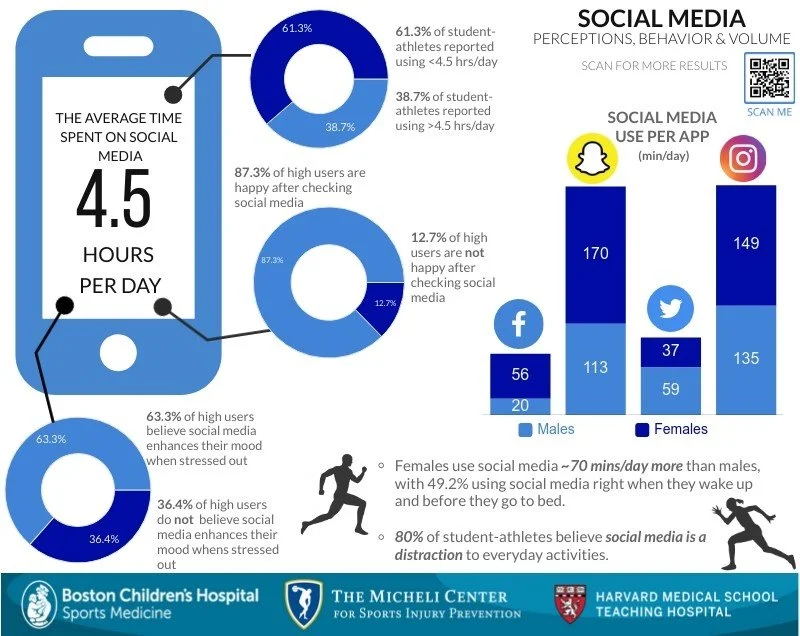
Adding social media to the mix: A recent article published by The Micheli Center for Sports Injury Prevention found that The average student-athlete in the study spent 4.5 hours per day using various social networking platforms. 20% of their day was spent using social media.
What are the health effects?
High-stress, over-performance and lack of true identity leads to burnout and unhealthy coping mechanisms. Studies show athletes have greater risk for anxiety, depression and other mental health disorders compared to their non-athlete peers.